Humans don’t work with their eyes alone. They feel a screw catch, hear a latch click, and know a part is still there when they look away. A robot that only sees stops at the surface. Neuron AI gives robots all the senses and the memory to make sense of them.
Robots that move. Robots that understand.
VISION-LED (VLA) MODELS
Optimised for motion.
Vision-led models do a lot well. But they judge by what the camera sees and reason mostly on the current frame.
WITH NEURON AI
Optimised for cognition.
Neuron AI does what a VLA does, and adds touch, sound and memory for what a robot cannot see.
How Neuron AI perceives the world
See
Geometry, colour and position in 3D. Neuron AI reads the scene as space, rather than a flat image, where every object stands and how it can be reached.
Feel
The contact on the surface, whether a screw catches or strips, whether a bag is full or empty. Tactile and force-torque data feed the model directly.
Hear
The click when something locks into place, out of sight. Audio turns invisible events into signals the robot can act on.
Remember
The world persists, even when no one is looking and time moves on. Neuron AI keeps track of what it has seen, so a part hidden behind another is still a part.
Five senses in. One action out.
Every modality is encoded, aligned in one shared space, over time and conditioned into a single action stream.
1
3D Vision
Point clouds and depth: the scene as space, not a flat image.
2
3D Vision
Force-torque and contact data from hands and grippers.
3
Audio
Contact sounds and spoken instructions.
4
Robot State
Joint positions, velocities and end-effector pose.
5
Language
Task prompts and physical concepts, aligned with what the robot senses.
Where vision stops, the other senses take over
Some tasks cameras cannot solve on their own. Extra senses also improve the tasks vision already handles.
Sense the lock opening
A camera can’t tell if a lock has opened. Sound and touch can.
Grasp the unseen
Touch guides the grip when an object is hidden from view.
Hear the seam
In welding, the sound of the process reveals the quality of the seam.
Intelligence that runs on the robot itself
Neuron AI is deployed locally, intelligence that runs on the robot itself. Decisions happen in real time on the robot, without relying on the cloud.
Low latency
Decisions are made directly on the robot, with no round trip to a server.
Real time
ON THE ROBOT
Resilience
Neuron AI keeps working without a cloud connection.
No cloud
REQUIRED
Data control
Production data stays under your control, a key point for manufacturers in Europe.
Your data
STAYS WITH YOU
One model for every NEURA robot
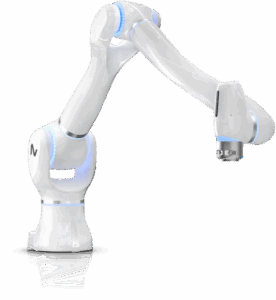
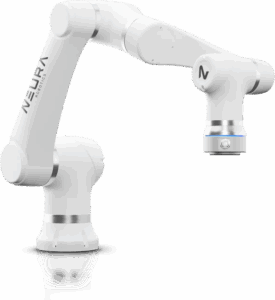
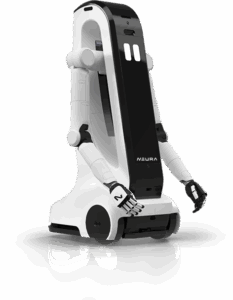
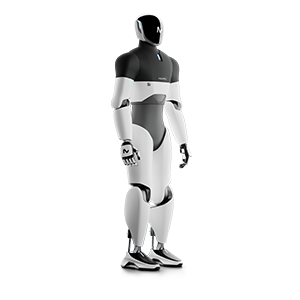
Neuron AI is trained across the NEURA robot family and its hands and grippers: one model, deployed on every embodiment.
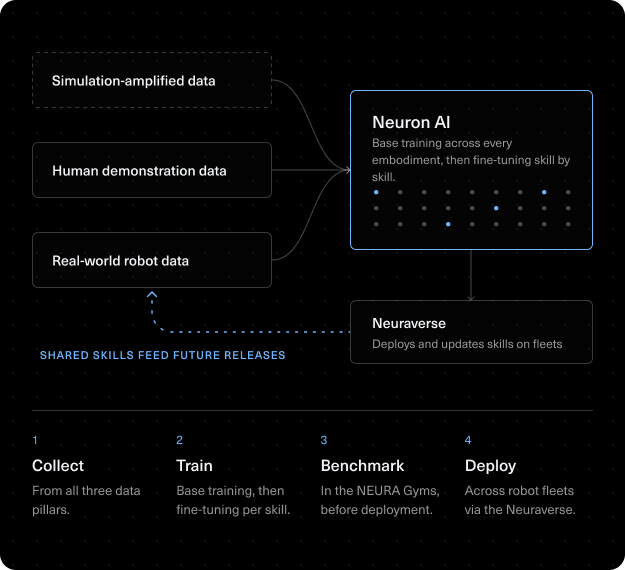
Neuron AI is trained on three complementary sources of physical experience: real physical interactions, simulated variation and human know-how. Data partnerships with industrial companies including Schaeffler and Bosch complement training in the NEURA Gyms.
Real-world robot data
Robots across different embodiments perform tasks in the NEURA Gyms and in real-world environments, generating synchronised vision, touch, force, audio and movement data.
Simulation-amplified data
NEURA’s Data Amplifier and simulation stack expand training data through simulated variations of tasks and environments.
Human demonstration data
People wearing sensor-equipped data suits capture movements and task demonstrations, bringing practical expertise into training.
A PLA model connects what a robot sees, hears and feels with what it has already done. Neuron AI encodes 3D vision, touch and force, audio, robot state and language in one shared space over time, and turns them into a single stream of action.
A robot acts in a continuous physical world. It has to keep track of objects and the consequences of its own actions, often without seeing them. Neuron AI remembers objects when they are out of sight.
Neuron AI was developed and trained in-house in Metzingen, Germany. It learns from three data pillars: real-world robot data, simulation-amplified data and human demonstration data.
Ready to give your robots all their senses?
Talk to our team about Neuron AI on your robots, your use case and your data.