




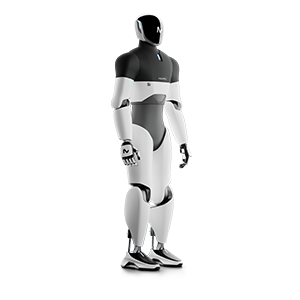


Health Care
Inpatient and outpatient care, plus clinical assistance tasks.
Call for proposals · Funding year 2026/2027
From the Lab. Into the Real World.
Funding, platform access and application partners to take your Physical AI research to pilot readiness on MiPA, in health care, retail and hospitality.
Many promising Physical AI approaches never reach productive use. What they lack is access to real application environments, data infrastructure and piloting partners.
The NEURA Research Programme gives selected teams exactly that: an industrial robotics platform, foundation models, data infrastructure and application partners. The goal is to take existing research results to pilot readiness, and to pool research forces across Germany and Europe on one platform.
Objective 1 · Use cases and skills
Transfer your technology into the segments where NEURA already has access to application partners. Basic skills like grasping specific objects, complex skills like opening doors, or the integration of existing skills into MiPA all qualify.
Inpatient and outpatient care, plus clinical assistance tasks.
Product availability, shelf replenishment and customer interaction in brick-and-mortar stores.
Service and guest interaction in hotels and restaurants.
Objective 2 · Use-case-independent capabilities
These dimensions form the technical evaluation framework for every proposal. A clear, substantial contribution to a single dimension is enough. Your proposal can address one objective or both.
Learn new skills from a few demonstrations instead of extensive training datasets.
Carry learned skills over to new configurations, objects and deployment environments.
Handle previously unknown objects and tasks with fine-motor precision.
Clarify ambiguous or incomplete instructions, and still carry them out reliably.
Operate independently and resist disruption over extended periods without constant supervision.
Run learned capabilities fast enough for productive, economic use.
What selected projects get
Three NEURA contributions for the development, training and piloting of your
capabilities.
Each one is described in detail in the annexes of the call.
Required · Annex 1
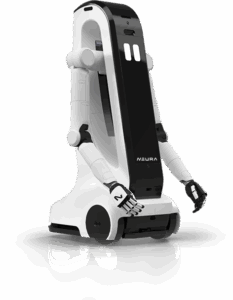
Mobile dual-arm service robot with an open software API. The hardware and software basis for developing, integrating and testing your capability. Provided under a monthly leasing model.
Annex 2
Real-world test environment to integrate, train and evaluate capabilities on the target system. Collect data remotely with MiPA and feed it into the NEURA Gym data pipelines.
Annex 3
Simulation and exchange platform: digital twin, integrated data recorder, training and qualification, plus a marketplace to publish your own skills and models.
Good to know: the costs of NEURA's contributions, in particular the MiPA leasing rate and NEURA Gym Services, are covered from the granted funding and must be included in your work and cost plan. Full details in the call.
Eligibility
Selection criteria
The NEURA Research Board assesses every proposal against four main criteria.
Novelty and differentiation of your technology or training method compared to the state of the art.
A substantial contribution to at least one segment and one or more capability dimensions.
Maturity at project start, plus a specific and plausible development path to TRL 6–7.
Demonstrated experience piloting robotic systems in real-world application environments.
How to apply
Read the full call for proposals and the three technical annexes on MiPA, NEURA Gym and Neuraverse.
Max. six pages in English or German, plus CVs and letters of intent. Include a work and cost plan: up to €500,000 over 12–18 months.
Send your proposal as a single PDF to [email protected] before 24:00 CET.
Project start is subject to a separate cooperation agreement with NEURA.
Get a deadline reminder and news about the NEURA Research Programme.
More questions? Write to the Programme Office
[email protected]
Universities, higher education institutions, publicly funded research institutes and startups established in Germany, another EU Member State, the United Kingdom or Switzerland.
No. MiPA is provided under a monthly leasing model. The leasing rate is paid from the granted funding and is set out in Annex 1 of the call.
No. Early-stage research is eligible. What counts is a credible path to TRL 6–7 within the funding period.
Yes. Joint projects with several eligible institutions, and cooperations with application partners from the target segments, are welcome and viewed favourably.
Max. six pages in English or German, plus CVs and letters of intent. The call lists all required elements, including the work and cost plan.
Proposals are handled with due care and only shared with people involved in the evaluation. Do not include information you consider confidential. NEURA assumes no confidentiality obligation.
Proposals close on 30 October 2026, 24:00 CET.
Download the call and start your proposal today.