





A joint research and training center brings together robots, science and industrial expertise. To mark the opening, NEURA unveils its new humanoid robot, 4NE1 Gen 4.
- From experience to skill: At the TUM RoboGym powered by NEURA, researchers and companies develop robotic skills for concrete tasks, from manufacturing and logistics to applications in agriculture and healthcare
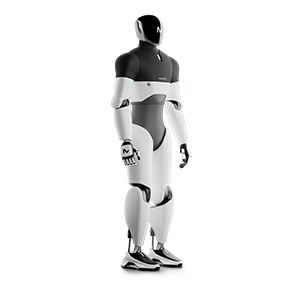
- Introducing the next generation: 4NE1 Gen 4 is designed for serial production, 20 percent lighter than its predecessor, features a slimmer design with a black textile outer skin, includes an advanced motion control system and runs on Neuron AI, NEURA’s foundation model for Physical AI
- Infrastructure for the future: Real-world robot data, human demonstrations and simulation form the foundation for machines that can learn. Munich marks the start of a planned international network of NEURA Gyms
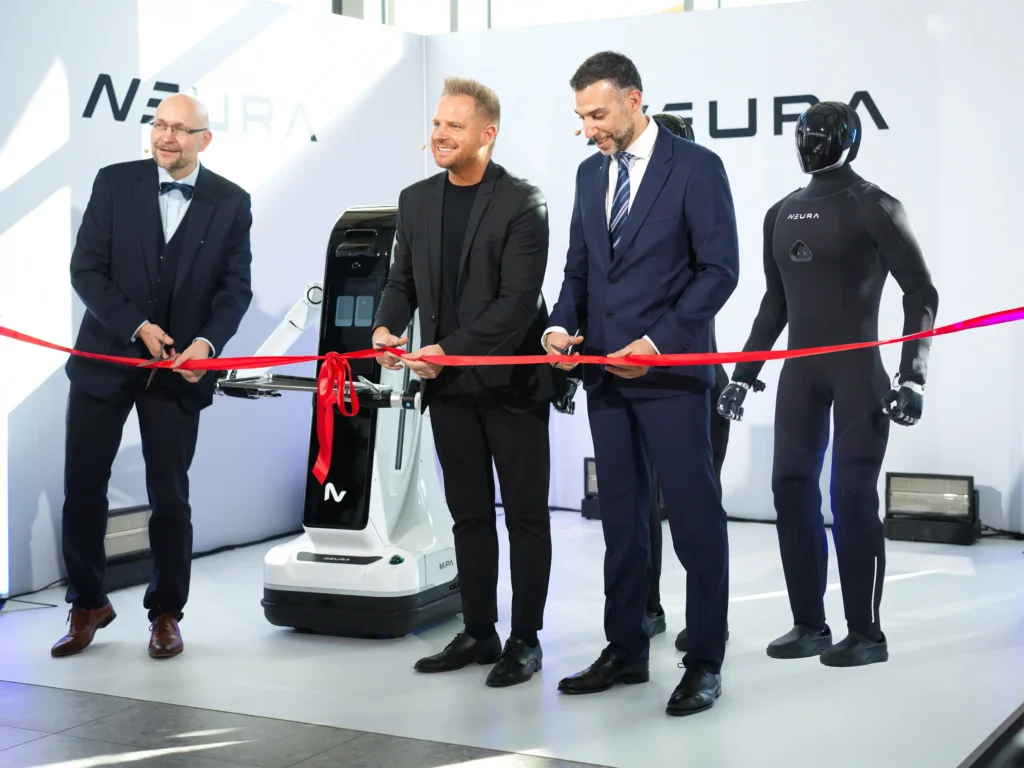
Munich, 22 October 2026 – NEURA Robotics and the Technical University of Munich (TUM) today opened the TUM RoboGym powered by NEURA at LabCampus near Munich Airport. Spanning more than 2,300 square meters, the new center brings together research, robot training and industrial application. It was built in partnership with TUM’s Munich Institute of Robotics and Machine Intelligence (MIRMI). To mark the opening, NEURA is also launching 4NE1 Gen 4 (“For Anyone”), the new generation of its humanoid robot.
The RoboGym brings together AI research and industrial application. Companies contribute concrete tasks and their process knowledge. Researchers and development teams investigate how robots can learn these tasks faster and perform them more reliably.
“Our companies hold knowledge that has been built up over generations,” said David Reger, Founder and CEO of NEURA Robotics. “People know how to work materials, assemble components and master difficult processes. This knowledge is one of our greatest strengths in the age of Physical AI. With TUM, we are building a powerhouse for physical capabilities, where this knowledge becomes the foundation for new possibilities. The Mittelstand, in particular, should be able to help shape this future. With the launch of the humanoid 4NE1 Gen 4, we are showing today which robots are ready for it: designed for series production, built for productive work and powered by Neuron AI, our own foundation model that learns from experience in the NEURA Gyms. Developed, built and trained in Germany, for the world.”
A place where companies teach robots their work
Partners have been training concrete workflows at the TUM RoboGym since September. Companies from more than ten industries are involved, including automotive, pharmaceuticals, medical technology, packaging, logistics, agriculture and care. Demand is high: capacity in Munich is already in strong demand.
Tasks range from handling cardboard boxes and filling bottles to loading and unloading wooden components. Companies can test applications, identify training needs and assess the suitability of different robot systems before expanding use in their own operations.
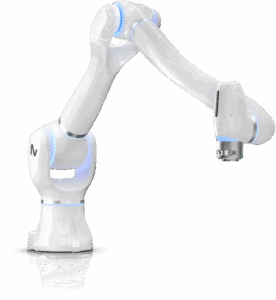
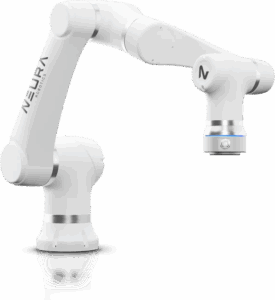
Various form factors are available for this: humanoid robots, mobile assistance robots such as MiPA, and cognitive robot arms. What matters is the capability a given task requires. To support this, the Center provides a shared development environment for academia, established companies, and startups.
“The TUM RoboGym robotics center is unique in Germany and Europe,” said Prof. Thomas Hofmann, President of the Technical University of Munich. “By collaborating with a robot manufacturer based in Germany, we are also sending a clear signal for Germany as an industrial location in geopolitically uncertain times.”
Three paths to physical experience
How does a robot grasp a delicate component? How does it recognize that two parts have been correctly joined? And how does it respond when a workflow changes? Capabilities like these are built through experience with the physical world. Physical AI requires data on how objects, materials and forces behave in the real world. The RoboGym combines three approaches to generate this data:
- Real-world robot data: Different robot systems perform tasks. Their sensors capture movements, contacts and the outcomes of their actions.
- Human demonstrations: People demonstrate workflows. Sensor-equipped data suits, motion-capture systems and teleoperation help translate movements and interactions into usable training data.
- Simulation and Data Amplifier: Virtual training environments expand real-world experience with additional variations and situations, allowing skills to be trained under changed conditions and then validated on real robots.
The Neuraverse connects this training infrastructure with NEURA’s software and AI tools. For the joint research conducted by TUM and NEURA, training data is structured and processed for use in developing and studying Physical AI models.
At the center of it all is a practical question: how quickly can a robot learn a new task, and how reliably can it be performed?
4NE1 Gen 4: new hardware for robots that can learn
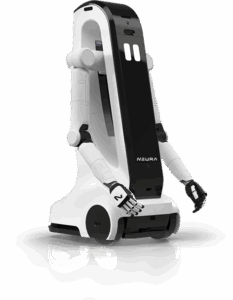
With 4NE1 Gen 4, NEURA is launching the new generation of its humanoid robot, already in operation at the TUM RoboGym for the opening: slimmer, lighter and powered by Neuron AI as its brain.
- New design, lighter body: 4NE1 Gen 4 has a slimmer body, a textile outer skin and is 20 percent lighter than the previous generation. The fabric makes the robot appear more approachable: it is built to work alongside people, and designed to look the part. The material also offers potential for further, simple customization.
- More precise handling: Advanced hands enable even more accurate grips. Added to this are Smart Limbs: reflexes are built directly into the limbs, so each limb can respond independently. This allows 4NE1 Gen 4 to react instantly to its environment and move more fluidly and in a more human-like way.
- Neuron AI, the brain: 4NE1 Gen 4 runs on Neuron AI, NEURA’s Perception-Language-Action model for Physical AI. It translates what the robot perceives directly into movement. Alongside vision, touch, force, sound and the robot’s own state also feed into the model. This makes a real difference for industrial tasks in particular, for example when a robot needs to recognize whether a fastener has clicked into place. Neuron AI is trained on real-world robot data from the NEURA Gyms, human demonstrations and simulation. Through the Neuraverse, skills learned by one robot become available to other connected robots as well. As a result, 4NE1 Gen 4 benefits from everything learned across the growing network of NEURA Gyms.
4NE1 Gen 4 is being prepared for series production. Alongside the opening of the TUM RoboGym in Munich, it is also appearing at the NVIDIA GTC conference in Berlin and is already in operation at the NEURA Gyms. At these training facilities, companies can train tasks with the new robot generation, making them among the first to work with 4NE1 Gen 4.
Research and industry develop together
The TUM RoboGym gives researchers, students and companies access to a shared research and training infrastructure. Scientific findings can be tested here under practical conditions, while industrial tasks in turn generate new research questions.
NEURA contributes robotics, technical infrastructure, computing power and operating staff, among other things. TUM provides space, scientific expertise and resources for research and operations. The joint initiative is initially set up for three years. In total, the partners are investing around EUR 17 million, of which NEURA is contributing approximately EUR 11 million.
“TUM MIRMI and NEURA Robotics have found two partners that can achieve great things together,” said Prof. Lorenzo Masia, Executive Director of TUM MIRMI and Head of the TUM RoboGym. “Building on our world-leading scientific expertise, we are now able, together with a strong industry partner, to prepare concrete applications for the market and make industrial robotics an important factor in the German economy.”
An international network begins in Munich
The TUM RoboGym marks the start of an international network of NEURA Gyms. Further locations are being established in Europe, the United States and China. In Germany, another Gym is being built in cooperation with RWTH Aachen.
“We want companies to carry their experience into the next industrial era,” said David Reger. “To develop capabilities, protect their know-how and decide for themselves, in the future, where and under what conditions they make it available to others. What we are opening today in Munich is meant to have an impact far beyond this location. From Europe, together for the world.”
More Information: https://neura-robotics.com/neuragym/
About NEURA Robotics
NEURA was founded on the conviction that the next great technological revolution will not take place on screens, but in the physical world. As aging societies, labor shortages and the growing demand for skilled work reshape economies worldwide, Physical AI is becoming indispensable to safeguarding productivity, prosperity and quality of life.
Founded in 2019 and headquartered in Metzingen, Germany, NEURA Robotics is a global Physical AI company developing the technologies that enable intelligent machines to learn, adapt and work side by side with people in the real world. The company develops cognitive robots that can see, hear, feel and learn, as well as the software, AI and data infrastructure required to deploy them at scale.
A large share of global gross domestic product is generated today through physical work. NEURA’s mission is to make physical work scalable, drastically shortening the time it takes to teach machines new skills and deploy them worldwide. With its cognitive robots, the NEURA Gyms and the Neuraverse, an open ecosystem in which robots continuously learn and share skills, the company is building the foundation for a future in which intelligent machines help to solve some of humanity’s greatest challenges. NEURA Robotics builds Physical AI from Europe, together for the world.
About TUM MIRMI
The Munich Institute of Robotics and Machine Intelligence (TUM MIRMI) is an integrative research institute of the Technical University of Munich focused on robotics and AI. MIRMI holds leading expertise in key areas of robotics, including perception and data science. Nearly 80 TUM chairs are networked within TUM MIRMI to develop robotic and AI-supported solutions for the environment, health, mobility, labor, and security and defense. Prof. Lorenzo Masia heads TUM MIRMI. His deputy is Prof. Achim Lilienthal.
More Information: www.mirmi.tum.de
Press Contacts:
NEURA Robotics: [email protected]
TUM: Andreas Schmitz, [email protected]
4NE1 Gen4 Media Hub: https://media-neurarobotics.px.media/collections/1521010597/media
