





A maintenance technician with 20 years of experience hears a bearing before it fails. He knows exactly how much force a seal needs to sit correctly. No manual taught him that. He earned it through thousands of repetitions, until it became pure instinct, a skill that’s nearly impossible to write down or hand over.
Now multiply that technician across an entire aging industrial workforce. As retirements accelerate, decades of hands-on expertise risk disappearing simply because it was never documented. Capturing it isn’t a nice-to-have anymore, but rather a necessity. The question is how you preserve knowledge that lives in a person’s hands.
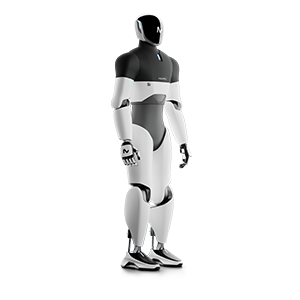
The answer is giving artificial intelligence a body. Physical AI, sometimes called generative physical AI, describes embodied systems that perceive, reason, and act autonomously in the physical world. Traditional industrial robotics performs well when the environment and task are fixed and known.
Physical AI operates at a different, more cognitive level: it adapts safely to unstructured environments, unfamiliar objects, and unexpected events, without being explicitly programmed for each one. It can recognize a component it has never seen before and know exactly how to grasp it.
Why training efficiently intelligent robots can’t wait
Four forces are pushing physical AI from ambition to necessity right now.
Skilled labor is disappearing faster than it can be replaced. Europe’s industrial workforce is aging, and the labor shortage that follows is becoming a real economic and social burden for manufacturers who depend on experienced hands to keep production running.
The data physical AI needs simply doesn’t exist yet. Large language models learned from a near-unlimited supply of text and video already sitting on the internet. Robots have no equivalent. Touch, force, sound, and spatial judgement were never digitized in the first place, which is why physical AI trains on roughly 120,000 times less data than today’s leading language models. That data has to be generated in the real world, one demonstration at a time. It can’t be scraped or simulated into existence.
Deploying automation without proof is a gamble few companies can afford. Robotics and AI-driven automation projects still fail on the shop floor more often than companies expect. The reason is that the system was never tested against the exact conditions it needed to work in. Getting this wrong isn’t only expensive, it can force a company to redesign entire processes around a robot that was never proven to fit them in the first place.
Trust and control now matter as much as capability. Industrial companies, especially in Europe, increasingly want their training data and trained skills to stay under their own control, processed on infrastructure they trust, not handed over to a foreign platform they don’t.
Put together, these four pressures explain why the market of intelligent and humanoid robots is moving fast. The companies that prove their use cases today, with far less risk and far less guesswork, will be the ones running physical AI in production while others are still deciding where to start. The longer a company waits, the further behind it starts.
NEURA Gyms: turning expertise into a deployable skill
Sounds compelling, but how do you actually get there without the infrastructure, hardware, or software to make it happen yourself?
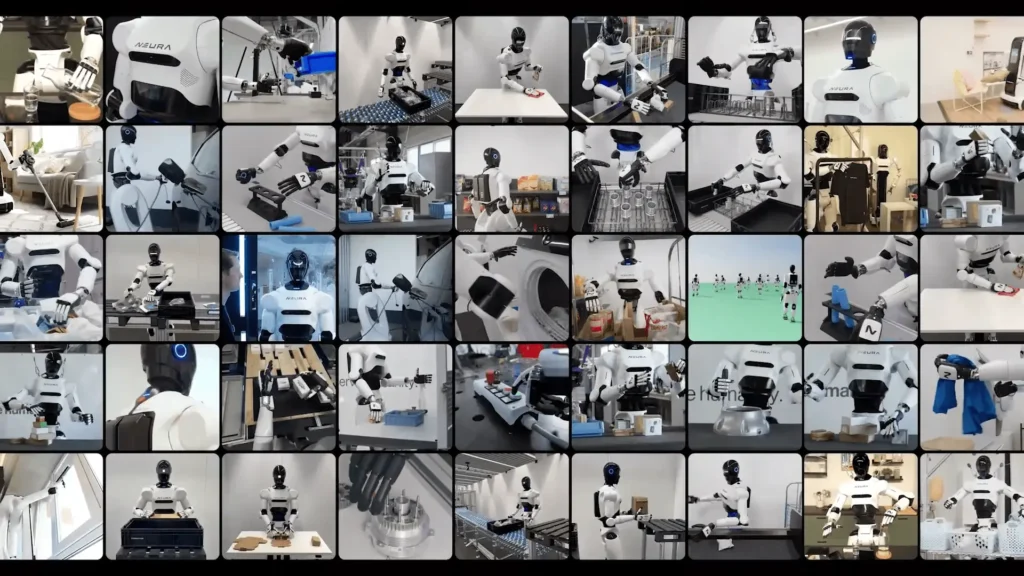
That’s exactly what the NEURA Gyms are built for: a global network of physical training facilities that turns decades of human expertise into scalable robot skills, one use case and one partner of NEURA at a time. Because every skill is trained and tested against real conditions before it ever reaches a production line, companies deploy with far more confidence, and far less rework, than starting cold on the shop floor.
What changes once companies start training their robots
Companies that start now get an 18-month head start and guaranteed priority access to the next generation of fully functioning, deployable cognitive and humanoid robots. In practice, that looks like:
- Your use case, defined and served by us. Training isn’t generic. Each facility is built around the partner’s actual process, and NEURA’s team scopes and runs the training cell together with them.
- You become part of a growing ecosystem, not a single vendor relationship. Every new location, every new partner, adds to a shared network of infrastructure, expertise, and trained skills.
- Your data stays with you. Training data and models are stored and processed on European infrastructure, under the partner’s own control, not the provider’s.
- You get the full deployment cycle, not fragments of it. From use case assessment through to deployment on the physical robot, all the physical AI infrastructure components, hardware and software alike, come from a single, integrated pipeline, not a patchwork of separate tools and vendors.
- The Neuraverse turns your skill into an asset. Once a skill is trained, it doesn’t have to stay locked inside one factory. Through the Neuraverse marketplace, partners can license their trained skills to other companies, or draw on skills other partners have already built, effectively an app store for capabilities.
Become a founding partner of the NEURA Gym: Get in contact
