





Learning how to train a robot is no longer a software problem, it is a question of capturing human skill before it disappears. An ageing workforce is retiring, and with it goes decades of knowledge that lives in a person’s hands rather than in any manual. Physical AI, and the cognitive robots it powers, exist to preserve that expertise.
To move forward fast, we established our NEURA Gyms: a global network of physical training facilities where decades of human expertise are turned into real-world training data, and ultimately into scalable robotic capabilities.
How to Train a Robot: the End-to-end Physical AI Pipeline
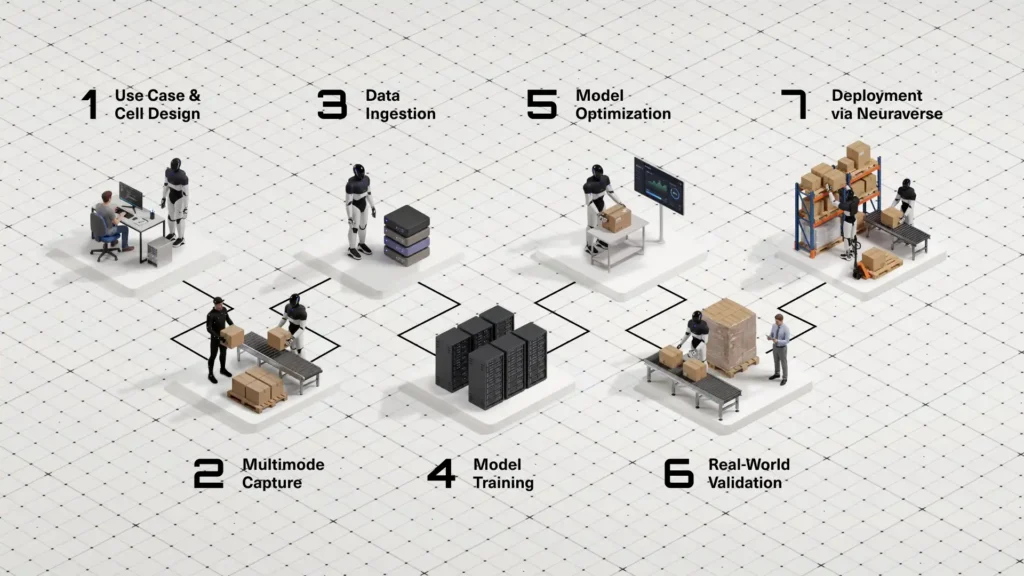
So what does it actually take to train a robot for a real production task? Inside the NEURA Gym it takes shape as a structured technical process: seven clearly defined stages that together form the full training and deployment cycle. Here’s how each one works, from the first definition of a use case to a validated skill running in production.
1. Define Use Case & Cell Design
Every deployment starts by defining together exactly what the physical AI robot needs to do. This isn’t a generic capability, but a specific task mapped to the partner’s own processes, requirements, and the environment it will run in. From there, we assess what relevant data already exists, what still needs to be collected, and where the cognitive robot is expected to operate.
Next, we build a cell that replicates the partner’s real environment. Working from their tools, fixtures, and equipment, we recreate their exact conditions inside the Gym, so the skills the cognitive robot learns here transfer directly to their facility. That precision pays off at deployment. With the use case clearly defined and the cell replicating the partner’s conditions from day one, the result is a skill purpose-built for that environment rather than a generic model, sharply reducing deployment risk.
2. Multimode Capture: How the Robot Gathers Real-world Experience
This is the part of how to train a robot that cannot be shortcut: the robot must have experienced the physical world firsthand before simulation or model training can begin. This indispensable foundation of reinforcement learning is built through three complementary methods in the NEURA Gym:
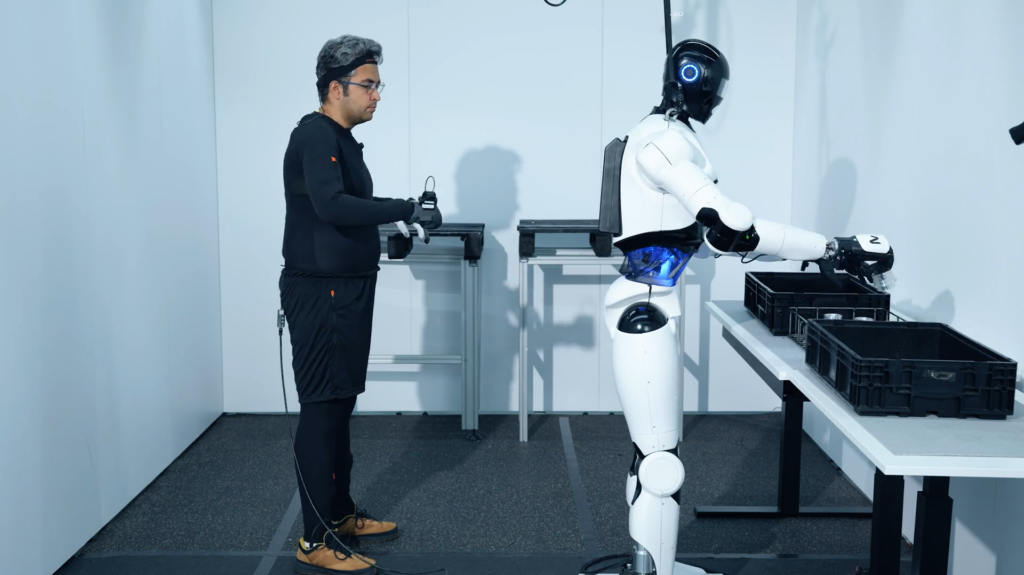
- Teleoperation: A human operator wears a sensor-equipped data suit and performs the task, while the AI robot mirrors every movement in real time. All sensor data is recorded simultaneously: poses, forces, camera streams, touch data, and audio.
- Field data collection: Employees at the partnering companies wear data suits during their regular shifts, thereby generating real-world data that cannot be obtained anywhere else. This enables the embodied systems to learn in a real production environment and respond to their full complexity and variability.
- Simulation as support: In addition, real-world data collection is supplemented by simulations in a virtual environment. The establishment of digital twins proves to be particularly efficient and cost-effective in this context. They form the basis of every simulation and are an exact mirror image of the robot and its physical environment. This allows all actions to be perfectly replicated, enabling potential sources of error to be identified more quickly and optimized in the real-world environment.
3. Data Ingestion
At the same time, general knowledge from large behavior models (LBMs) is folded into the training model, basic things like what a wrench is, what “left” means, or how a person moves. That prior knowledge cuts training time significantly, but it doesn’t replace physical experience, and it doesn’t fully solve physical AI on its own.
Most vision-language-action models available today are trained on internet data and are frame-based: they read the current moment well, but they don’t carry a memory of what happened five seconds ago, or track how a task is unfolding over time. That’s why NEURA also builds its own physical AI foundation models on top of this ingested knowledge, models designed to hold onto a sense of memory and combine vision with touch and audio, rather than vision alone.
4. Model Training: Turning Captured Data into a Robot Skill
The collected data then passes through automated pipelines for annotation, curation, and training until the policy meets the required standard. Annotation relies mainly on self-supervised methods and ground-truth sensors worn by both the human operator and the robot, combined with large vision-language models that auto-label the bulk of the data. Manual labeling is reserved for genuine edge cases only, which keeps cost and turnaround low.
5. Model Optimization
With a working model in place, the focus shifts from getting the task done to getting it done reliably, every time and across variation. The team refines the model’s behavior across repeated iterations, adjusting parameters and retraining as needed to sharpen accuracy and consistency.
Much of this work targets edge cases: the unusual grips, angles, lighting conditions, or object variations that a first-pass model handles poorly, but that occur often enough in the real world to matter. Each weak spot is identified, addressed with targeted adjustments or additional data, and re-evaluated. The cycle repeats until performance holds up not just on average, but across the full range of conditions the task demands.
6. Real-world Validation
The model is tested with the robot in the loop, under the real conditions it will eventually work in. If it doesn’t yet meet the reliability threshold needed for production, the team works out whether the issue is more data, better-quality data, or adjustments to the model itself. This loop repeats, sometimes several times, until the skill is consistently reliable enough to deploy.
7. Deployment via Neuraverse.
Once validated, the skill is published to Neuraverse for the customer to use and deploy across their fleet. The data and trained models remain theirs. Nothing is shared unless the customer chooses to monetize their skill through the Neuraverse marketplace.
From one trained robot skill to fleet-wide capability
These seven stages answer the question of how to train a robot in a way that is repeatable rather than a one-off project rebuilt from scratch each time.
The real advantage comes after deployment. A skill trained once doesn’t stay on one robot. It scales across an entire fleet of humanoids, and through Neuraverse it can reach robots well beyond a single facility. This is what sets cognitive robots apart from conventional automation: a programmed machine must be re-engineered for every new line or task, while an intelligent humanoid simply loads a new skill and adapts. Every use case trained in the Gym compounds, and each one makes the next faster to build. That is how physical AI moves from a promising demonstration to production at scale.
Ready to lead with Physical AI? Locations are opening across Europe, China and the US, with more to follow world-wide. Additional locations are built where founding partners commit. Secure your cell, shape the standard, and build the skills that define your industry´s competitive edge before others do.
